library
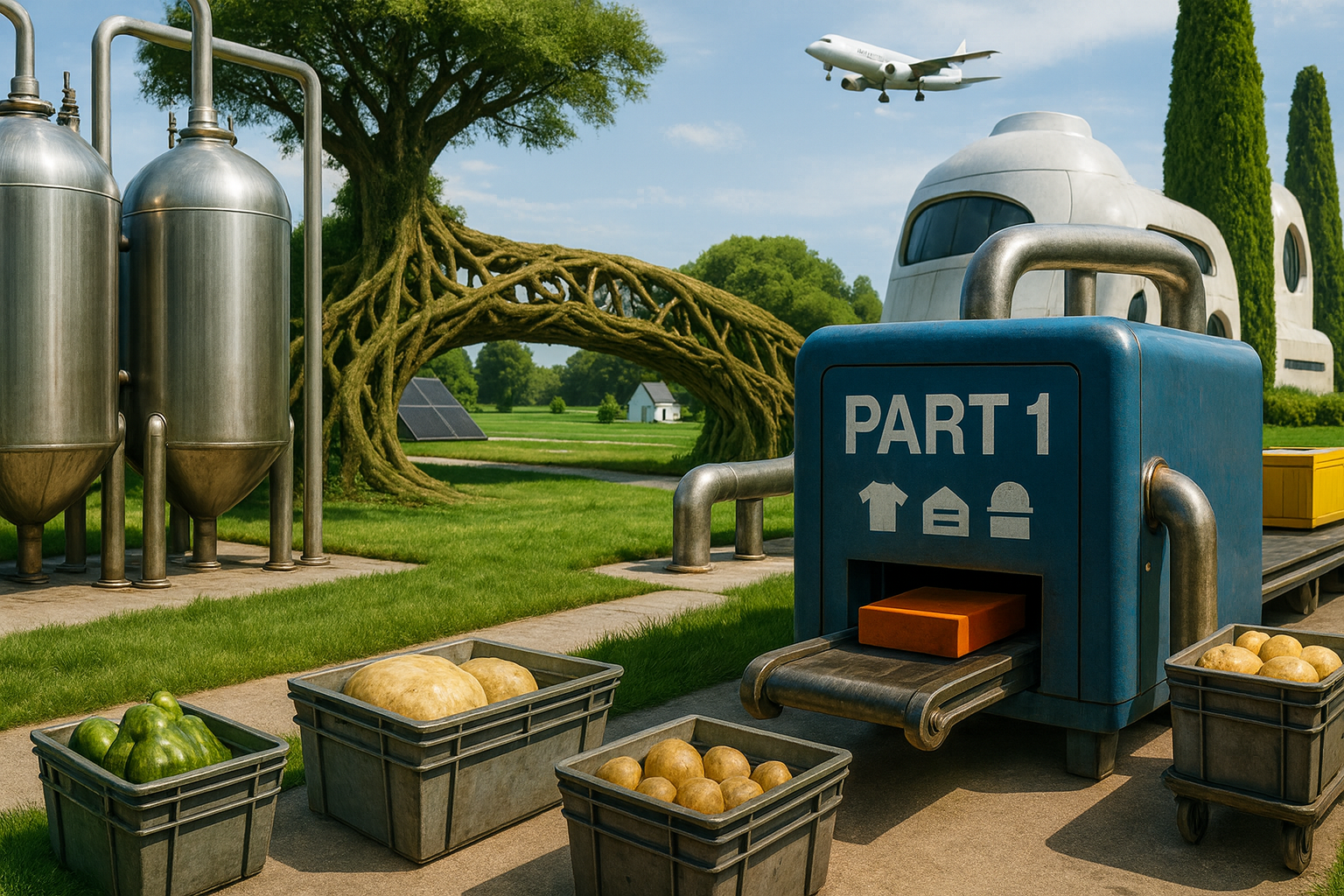
Image generated using ChatGPT. A futuristic bio manufacturing plant producing food, fabrics, and buildings with fermenters and hand engineered tree bridge. Later retouched. November 24, 2025.
Much has been written in the years since the onset of the COVID-19 pandemic about the fragile state of critical U.S. supply chains. Our colleagues recently discussed the need to foster world-leading and home-grown battery and nuclear energy industries. But the list of materials for which we rely substantially or entirely on non-U.S., non-allied sources is broad, including everything from medicines to rare earth metals. To enhance national security and economic competitiveness, there are now major efforts underway to “re-shore” the manufacturing of these and other vital materials back to the U.S. Biotechnology is a long-recognized production powerhouse in traditional applications such as health, food, and agriculture. Now, it has the potential to unlock a multitude of new applications and serve as an essential pillar of the nation’s strategic industrialization toolkit.
Time-tested, long-known…
Biology is earth’s most powerful manufacturer. Over four billion years, life on Earth has reorganized matter with atomic precision and planet-wide impact. Living things are found everywhere on Earth: from pole to pole, in the deepest ocean trenches, in the air, and far below ground. Biology created Earth’s oxygen atmosphere. Biology is self-replicating and self-repairing. Biology senses and responds to its local environment, having developed the means to adapt both in the moment, and across generations. Humans have manipulated biology over millennia to cultivate life-sustaining crops from wild grasses and develop highly productive livestock from wild animals through generation over generation of selective breeding. More recently, fermentation (use of microbes to convert sugar into other materials) has been harnessed to preserve foods and eventually to produce medicines. These most foundational tools, propelled forward by the expanding toolkit of biotechnology (more on this in Part 2), have enabled engineering biology in increasingly complex ways.
…But only recently understood
.jpg)
Only in the last century have we begun to understand how biology shapes matter, discovering the code containing the instruction set of life. Having done so, we have accelerated the discovery of new natural substances (like penicillin) and then adapted biology to springboard the development of biology-inspired but wholly new antibiotics, and sophisticated new classes of medicines (biologics) with the ability to treat previously intractable cancers. Biotechnology innovations have also accelerated development of specialized crops and enhanced our capacity to produce foods, fibers, and fuels. Now, our ability to engineer biology and innovations in biomanufacturing are leading to new paths to speed and scale production of a diverse universe of molecules, opening up a new role for biotechnology in everything from medicine to mining.
Emerging Applications
The continuing pace of biotechnology innovation, in part fueled by the convergence of capabilities from other science and engineering disciplines, has created both new tools for engineering biology and opportunities for biotechnology platforms and products to achieve multi-sectoral impact.
- An expanding library of chemical ingredients: Engineering biology approaches to design new target molecules and program their production in microbes have yielded new pathways to produce strategic compounds. One such example is the advanced microbial biosynthesis and fermentation-based production process developed by Antheia for producing key starting materials and active pharmaceutical ingredients for essential medicines. This approach helps reduce U.S. dependence on foreign manufacturers.
- Securing critical minerals: In addition to producing new high-value molecules, biology’s unique properties can also be used to manipulate or process other materials. For example, Alta Resource Technologies is using designer proteins to separate rare earth elements from domestically mined ores.
- Information storage: Long relevant to research and therapeutics, DNA synthesis and sequencing has progressed to a scale where it can be the foundation for enterprise data storage systems. Atlas Data Storage is pioneering high-efficiency DNA synthesis as a commercial data storage platform.
Notably, each of these companies combines engineering biology capabilities with an interdisciplinary array of technologies for their implementation, yielding diverse opportunities to create a secure and resilient domestic supply chain.
Why aren’t we there yet? What are some challenges?
As impressive as biology, a planetary-scale phenomenon, is, there remain some significant challenges to fully realizing its potential in revolutionizing manufacturing both here in the U.S. and globally.
- Biology has been successfully harnessed to make a diverse array of products that are composed of proteins, generated with enzymes, and sometimes even built with whole cells; however, advancing new products from discovery to a commercially relevant scale in competitive timelines and efficiencies can be time-consuming and capital-intensive. In particular, resource-limited startups are often dependent on low-cost foreign suppliers of materials, reagents, and infrastructure as they push toward commercialization.
- Biology mostly works on substances comprised of the elements that make up life: carbon, nitrogen, oxygen, and hydrogen. However, many things we need are made of elements that have either few roles in biology (silicon, rare earth metals, some forms of carbon like graphene) or are used by biology in small amounts relative to carbon (many transition metals). While biology is a manufacturing solution for a wide variety of products, time and innovation will be needed to expand the scope of materials and products that it can be harnessed to make (as noted above in the example of rare earth elements).
- Engineering biology products face unique challenges making it to market, such as resource-intensive regulatory requirements. These products often struggle to reach cost parity with those made by a conventional but less sustainable industry — petroleum chemistry — that is already well-entrenched but has its own problems: a finite supply that is unevenly distributed and substantially outside the United States, polluting, and contributes to anthropogenic climate change. Additional opportunities to create economies of scale (i.e., in core facilities, contract manufacturing, etc.) will be required to support companies through commercialization and to create incentives for early adoption.
The United States has long been a world-leading innovator in biotechnology, but U.S. leadership in this domain in the long term is far from guaranteed. Where Chinese companies once struggled to replicate U.S. successes in biotech products like immunotherapies, they are now developing first-in-class treatments for a range of diseases. At the same time, China has emerged as a global hub for biologics manufacturing and research, supported by a regulatory framework that enables faster domestic approvals than many Western systems and is increasingly harmonized with international GMP and global regulatory standards. In our next blog, we will discuss in more detail several examples of how innovation can address the challenges mentioned above and where IQT has invested in platform technologies to strengthen and sustain U.S. leadership and economic security.