library
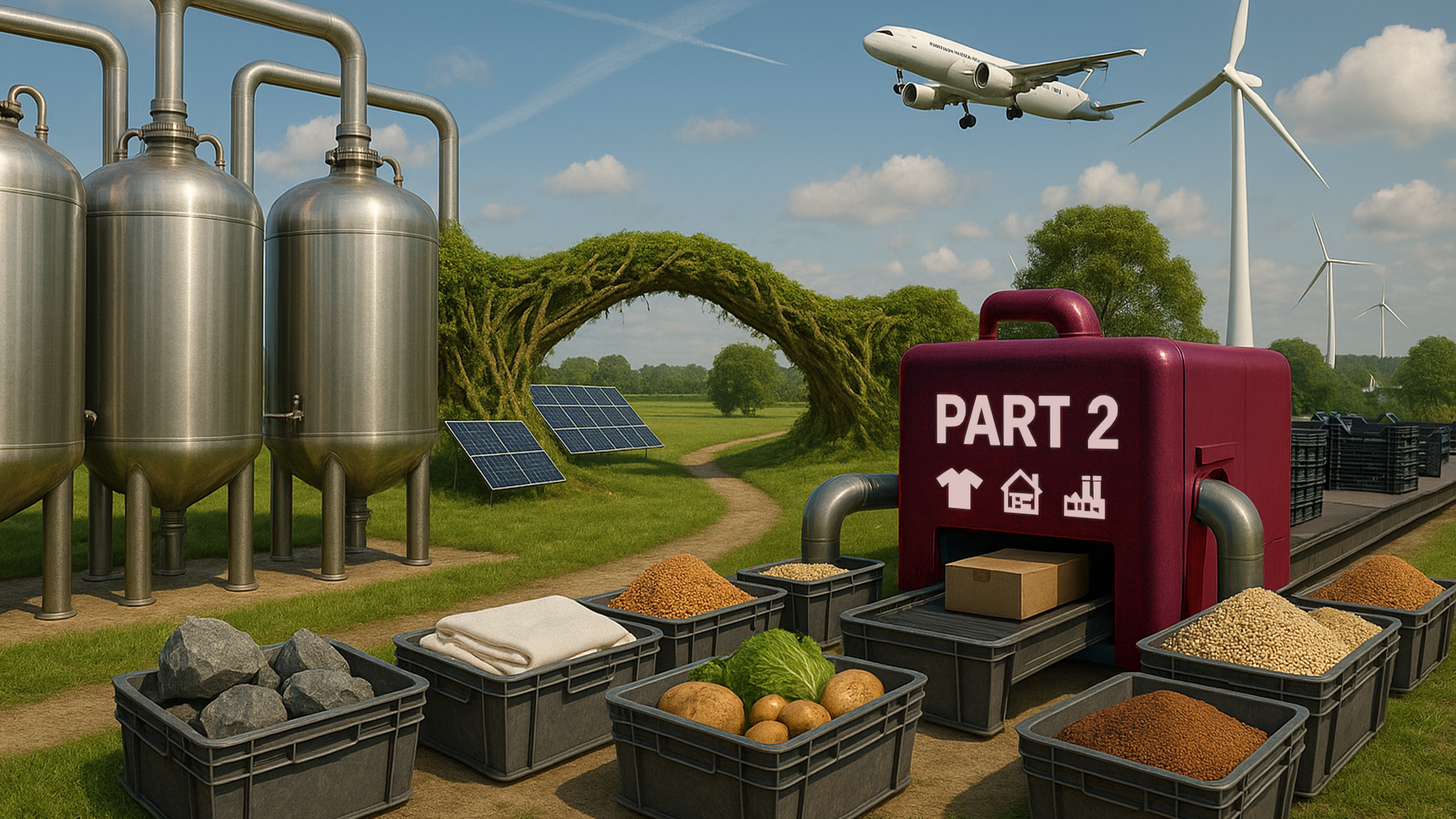
Image generated using ChatGPT. A futuristic bio manufacturing plant producing food, fabrics, and buildings with fermenters and hand engineered tree bridge. Later retouched. December 1, 2025.
We wrote in our last post about the astonishing power of biology to shape matter on enormous scales and the potential of harnessing biotechnology to reshape U.S. manufacturing. This includes producing innovative new products, reestablishing domestic manufacturing, securing supply chains, and achieving multi-sectoral impact. Engineering biology solutions have been demonstrated for lab-grown replacement organs, biological sources for plastics and agricultural fertilizers, self-healing materials that can withstand scratches and punctures, and many other products with the potential to enhance national and global security. But good ideas, and even great demonstrations, are not enough. Equally innovative tools and technologies are needed to drive down the costs and timelines required to take these ideas and early demonstrations to full-fledged commercial-scale capabilities.
Introducing The Engineering Biology Toolkit
For the past several decades, biotechnology has celebrated the integration of life science, data science, and engineering. We are now in a new era of “bioconvergence” where these interdisciplinary capabilities, further fueled by leap-ahead advances in artificial intelligence and automation, are advancing the toolkit underlying engineering biology. Achieving advanced manufacturing capabilities requires innovative tools and technologies that can swiftly transition ideas from early demonstrations to commercial-scale production. Shortening the time from discovery to production requires advancing a set of core biotechnologies — also known as platform biotechnologies — across three key areas:
1. Data and Discovery
2. Design and Build
3. Produce and Scale
These platforms will empower innovators to work faster and smarter than ever before, regardless of the specific application or use case.
Data and Discovery
Without question, artificial intelligence (AI) is transforming many facets of science and industry in the U.S. and around the world. One of the biggest barriers to unlocking the full potential of AI in engineering biology — whether in designing new molecules, optimizing manufacturing processes, or even in performing experiments — is the availability of high-quality data. Many AI models for biological design are based on limited and often poorly curated public data, then later refined on highly specific proprietary data that requires significant time, money, and expertise to generate. New tools and resources to generate high-quality biological data — from the molecular to the ecological scale — are necessary to move beyond inefficiently spinning the Design-Build-Test-Learn (DBTL) flywheel toward targeted, efficient design and production. Companies such as Swan Genomics, bitBiome, and Glyphic Biotechnologies are pioneering a new “next generation” sequencing wave, enabling DNA and protein sequencing at quality and resolution never before possible. Similarly, new experimental models, such as organs on a chip, engineered tissues, and others, are allowing R&D teams to generate better data faster and less expensively than animal experimentation can provide. For example, Cortical Labs has developed a "brain on a chip," and Inventia is pioneering a customizable tissue printing capability that can accelerate the investigation of diseases and assess efficacy of therapeutics.
Design and Build
A multitude of companies have been early adopters — and strong developers — of design capabilities; however, to test the hundreds or thousands of computational designs a model can generate, developers must ultimately convert their digital molecules into physical form for experimental, wet-lab validation. In the past, the “build” capability has largely been limited to DNA synthesis and subsequent production in microbes. The cutting-edge “build” toolkit is expanding beyond the basic building blocks of previous decades (i.e., synthetic DNA oligonucleotides) to making entire genes, proteins, and small molecules with complex stereochemistries. Companies like Elegen (DNA synthesis) and Tierra (protein synthesis) are developing new approaches to biological synthesis that enable production of large numbers of nucleic acid or protein constructs, at scale and cost effectively. Lila Sciences goes even further by integrating AI models with autonomous laboratory platforms known as AI Science Factories, to rapidly produce new scientific knowledge by traversing the digital-to-physical divide at unprecedented scale, speed, and accuracy.
Produce and Scale
Critically, technological innovation is also creating new approaches to make engineering biology products at scales and costs that are necessary to transform niche specialty ingredients to household items. Biomanufacturing at commercial scale requires innovation in both technology and in business. IQT portfolio companies Prolific Machines and Cauldron have developed methods for increasing the scale and reducing the cost of growing products based on mammalian and microbial cell culture, respectively. To accelerate the construction and access to commercial scale infrastructure, the tools of another portco, Synonym, allow companies to analyze the processes and economics of biotechnology products and design manufacturing approaches that can meet market demands.
Why Now?

Prioritizing biomanufacturing is critical because the power of biology can help us reduce reliance on foreign supply chains for necessities, such as the active ingredients in nearly all of our medicines (including essential drugs like antibiotics). U.S. dependency on foreign sources of medicines is a strategic disadvantage and a troubling potential source of leverage against the United States. While many advanced therapeutics — such as biologics and cell, gene, and tissue-based therapies — are still made domestically, much of the clinical and regulatory infrastructure needed to bring these treatments to market has shifted overseas, particularly to China. Meanwhile, China is rapidly advancing its biopharma capabilities through ambitious national strategies like “Made in China 2025,” “Healthy China 2030,” and the 14th Five-Year Plan. Avoiding dependence on an increasingly adversarial competitor for both generic and the most advanced therapies is, in a very real sense, a matter of national security.
Beyond pharmaceuticals, biology offers a path to domestic production of plastics, industrial chemicals, and building materials — products we currently import in vast quantities. Scaling biomanufacturing would not only strengthen supply chain resilience but also open new markets for American farmers, whose crops can serve as feedstocks for bio-based production, reducing their dependence on volatile global markets.
The COVID-19 pandemic and intensifying strategic competition with China have exposed the fragility of our supply chains. Now is the time for the United States to act — before the next crisis hits.